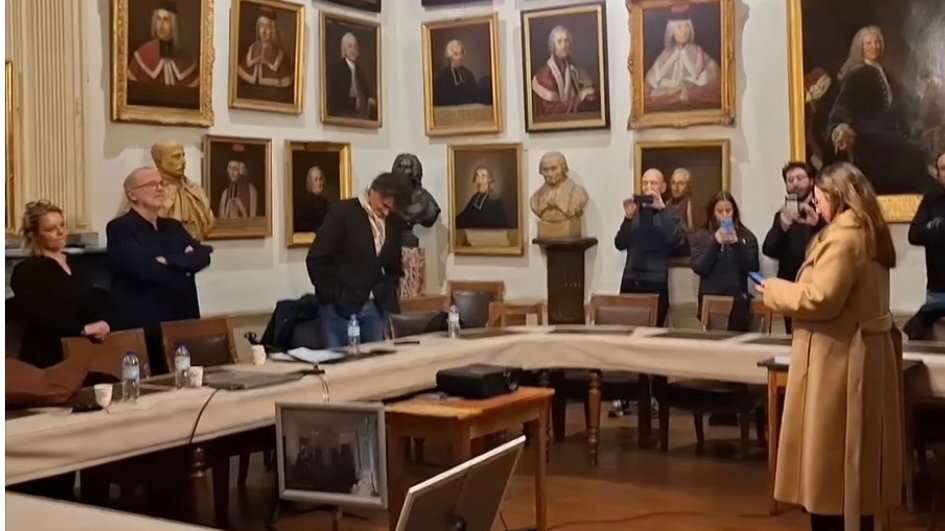
Thesis Defense by Magali Camelio-Aubac
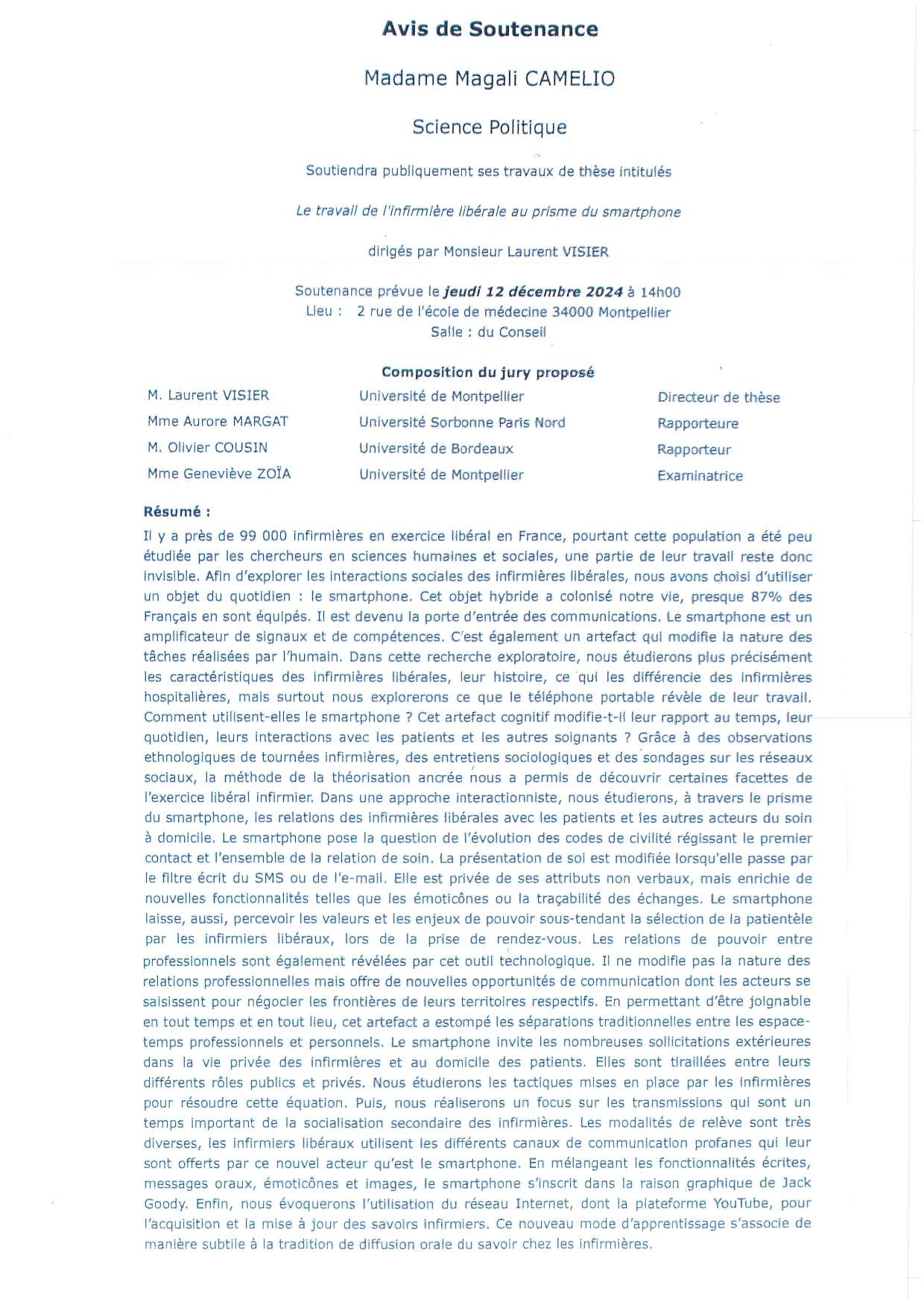
Ms.Magali CAMELIO-AUBACpublicly defended her dissertation, titled“The Work of Private-Practice Nurses Through the Lens of the Smartphone,”supervised by Mr.Laurent Visier, on Thursday, December 12, 2024, at 2:00 p.m., at 2 Rue de l’École de Médecine, 34000 Montpellier, Council Chamber.
Proposed Jury Membership
Mr.Laurent VISIER– University of Montpellier – Thesis Advisor
Ms. Aurore MARGAT – Sorbonne Paris Nord University – Rapporteur
Mr. Olivier COUSIN – University of Bordeaux – Rapporteur
Ms. Geneviève ZOÏA – University of Montpellier – Examiner
Abstract:
There are nearly 99,000 independent nurses in France, yet this population has been little studied by researchers in the humanities and social sciences; as a result, part of their work remains invisible. To explore the social interactions of independent nurses, we chose to use an everyday object: the smartphone. This hybrid object has become ubiquitous in our lives; nearly 87% of French people own one. It has become the gateway to communication. The smartphone amplifies signals and enhances skills. It is also an artifact that alters the nature of the tasks performed by humans. In this exploratory study, we will examine in greater detail the characteristics of independent nurses, their backgrounds, and what distinguishes them from hospital nurses; but above all, we will explore what the smartphone reveals about their work. How do they use the smartphone? Does this cognitive artifact alter their relationship with time, their daily lives, and their interactions with patients and other healthcare providers? Through ethnographic observations of nursing rounds, sociological interviews, and social media surveys, the grounded theory approach has enabled us to uncover certain facets of private nursing practice. Adopting an interactionist approach, we will examine—through the lens of the smartphone—the relationships between private practice nurses and their patients, as well as other home care providers. The smartphone raises questions about the evolution of the codes of civility governing the initial contact and the entire care relationship. Self-presentation is altered when it passes through the written filter of text messages or email. It is stripped of its nonverbal attributes but enriched with new features such as emojis or the traceability of exchanges. The smartphone also reveals the values and power dynamics underlying private nurses’ selection of patients when scheduling appointments. Power relations among professionals are likewise exposed by this technological tool. It does not alter the nature of professional relationships but offers new opportunities for communication that stakeholders seize upon to negotiate the boundaries of their respective spheres of influence. By making it possible to be reachable at any time and in any place, this device has blurred the traditional boundaries between professional and personal time and space. The smartphone invites numerous external demands into nurses’ private lives and patients’ homes. Nurses are torn between their various public and private roles. We will examine the strategies nurses employ to resolve this dilemma. Next, we will focus on handoffs, which play a significant role in nurses’ secondary socialization. Handoff procedures vary widely; independent nurses utilize the various non-professional communication channels made available to them by this new tool—the smartphone. By combining text messaging, voice messages, emojis, and images, the smartphone fits into Jack Goody’s concept of “graphic reason.” Finally, we will discuss the use of the Internet—including the YouTube platform—for acquiring and updating nursing knowledge. This new mode of learning subtly aligns with the tradition of oral knowledge transmission among nurses.